./Database
Open documentationCollection of datasets for audiovisual research in VR.
- Scene dataset of 360° 8K video and 4th-order Ambisonics audio
- Saliency dataset with 3-DoF viewing exploration
- CGI 6-DoF scene dataset with acoustic geometry
DFG SPP 2236 Audictive, Proj. No. 444832250
Project duration, 2024 - present
The EVOLVE-QoE project builds on the QoEVAVE project from AUDICTIVE Phase 1, aiming to bridge the knowledge gap regarding suitable audiovisual scene characteristics in Interactive Virtual Environments. The project pairs top-down, human-driven measures such as, exploration trajectories, physiological measures, and scene annotations, with bottom-up instrumental scene analysis, drawing on soundscape and visual-scene research to evaluate the ecological validity of IVEs within the QoEVAVE framework.
Read more about EVOLVE-QoE →Project duration, 2021 - 2023
Interactive virtual environments pose many challenges for quality, and quality of experience evaluations. Classical methodologies ask participants to engage in an explicit quality-judgment task, yet doing so disrupts the very immersion that defines the IVE experience. The QoEVAVE project addresses this gap by drawing on the virtual reality research tradition of indirect, behavior-based measurement, integrating these techniques into a QoE framework for multimodal, 3- and 6-degrees-of-freedom audiovisual environments.
Read more about QoEVAVE →The QoEVAVE and EVOLVE-QoE research projects provide datasets and software tools for audiovisual VR research. Each resource is independently documented and openly licensed for research use.
Collection of datasets for audiovisual research in VR.
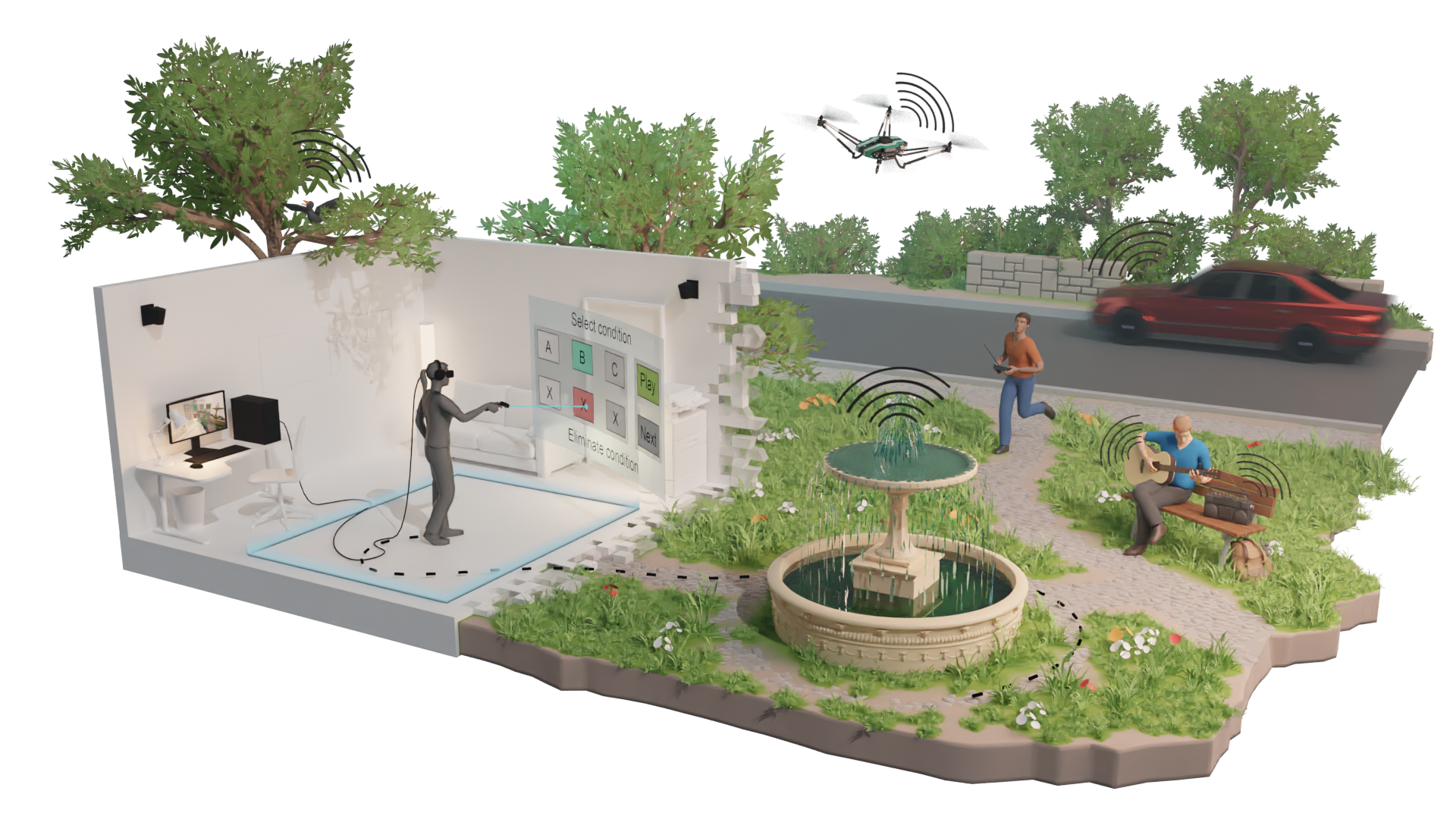
Quality of Experience evaluation tool for conducting subjective studies in virtual reality.