Questionnaires
Overview
Questionnaires can be employed alongside the primary evaluation method to capture additional attitudinal or cognitive dimensions beyond the main quality criterion. This is an optional component that supplements the mandatory test method.
QExE includes two questionnaires that have been used and validated in the course of the tool's development and associated lab research:
- NASA Task Load Index (NASA-TLX)
- Simulator Sickness Questionnaire (SSQ)
Questionnaire integration is controlled by two entries in the configuration file: questionnaireType and questionnaireIntegration.
questionnaireTypespecifies which questionnaire to use.questionnaireIntegrationcontrols when it is presented.
"questionnaireType": "NASA-TLX",
"questionnaireIntegration": "Lace"  // Inserted between each scene
"questionnaireIntegration": "End"   // Presented after the final scene
"questionnaireIntegration": "None"  // Questionnaire disabled
Questionnaires
questionnaireType : NASA-TLX
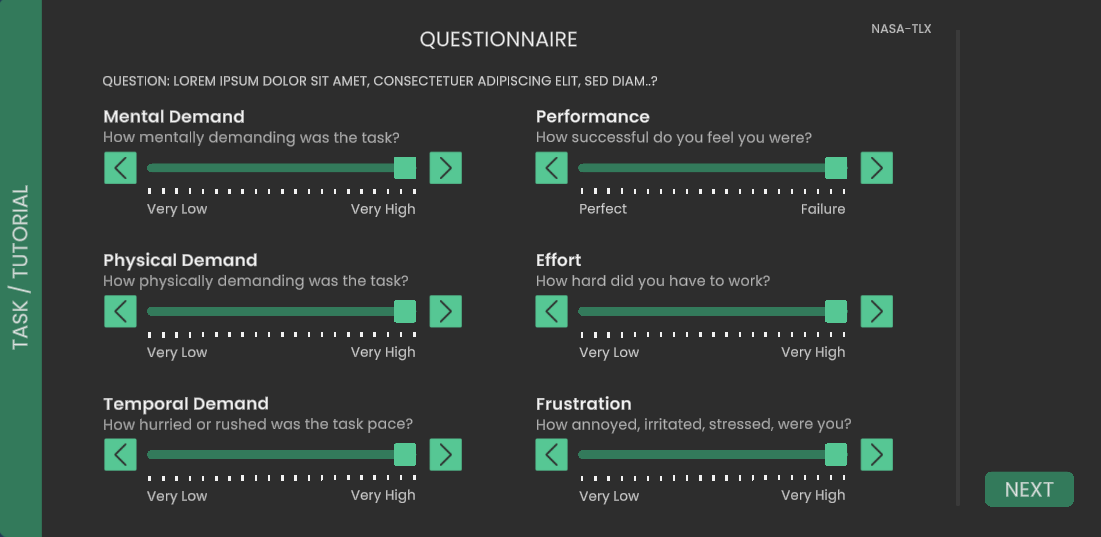
NASA Task Load Index
The interface features a continuous scale from 0–100, with verbal labels Bad, Poor, Fair, Good, and Excellent. No reference button is present, making all ratings relative to one another. As with MUSHRA, conditions can be selected with buttons A, B, C, etc.
| Dimension | Description |
|---|---|
| Mental Demand | How much mental and perceptual activity was required (e.g., thinking, deciding, calculating, remembering, etc.)? |
| Physical Demand | How much physical activity was required (e.g., pushing, pulling, turning, controlling, activating, etc.)? |
| Temporal Demand | How much time pressure did you feel due to the rate or pace at which the tasks or task elements occurred? |
| Performance | How successful do you think you were in accomplishing the goals of the tasks set by the experimenter? |
| Effort | How hard did you have to work (mentally and physically) to accomplish your level of performance? |
| Frustration Level | How insecure, discourages, irritated, stressed, and annoyed vs. secure, gratified, content, and relaxed did you feel during the task? |
questionnaireType : SSQ
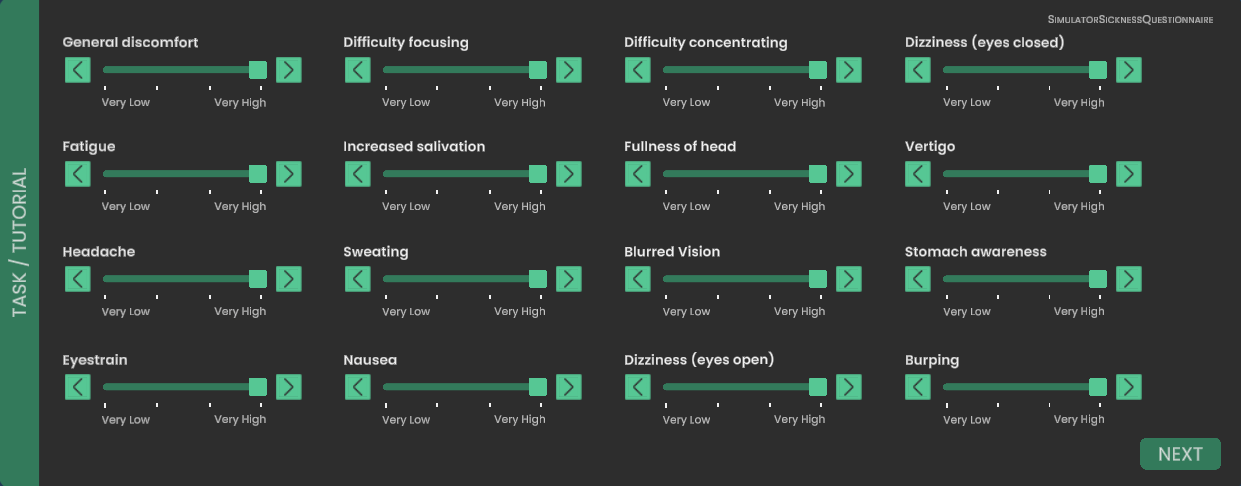
Simulator Sickness Questionnaire
The Simulator Sickness Questionnaire (SSQ) is widely used in VR research to quantify the adverse effects of virtual reality systems on user comfort. Sixteen symptom items contribute to three subscale scores, which are combined into a Total Severity score.
| Subscale | Description |
|---|---|
| Nausea | Symptoms related to gastrointestinal discomfort and general physical unease |
| Oculomotor Disturbance | Symptoms related to visual fatigue, eyestrain, and difficulty maintaining focus |
| Disorientation | Symptoms related to spatial disorientation, dizziness, and balance disturbance |